How to Use a PC Bottleneck Calculator to Maximize Efficiency
Bottlenecks are a common issue that many users face when it comes to the optimal performance of their PC. When any of your system components is restricting the performance of the other component, it’s more likely to reflect a bottleneck. Using a PC bottleneck calculator can help you identify the issues within your system.
Understanding Bottlenecks and Their Impact
Understanding the bottleneck is important for your PC’s performance. Fundamentally, when one component becomes the restricting factor that is hindering the normal performance of the other components, it may lead to a CPU bottleneck, a GPU bottleneck, or a memory bottleneck. Therefore, an understanding of a bottleneck calculator is important. For example:
CPU bottlenecking occurs when the CPU is the restricting factor that is limiting the performance of the other components or is unable to withstand the demands of the GPU or the other components of your system, reducing overall efficiency and optimization.
GPU Bottlenecking is reflected due to the absence of a powerful GPU or when the GPU is overworked, while the other components, like the RAM, are functioning normally.
Memory Bottlenecking happens due to slow RAM that cannot withstand the demanding tasks of your system.
Analyzing these bottlenecks by a bottleneck calculator is essential for an optimized performance of your system, and that is exactly the stage where the PC bottleneck calculator comes in.
Why Use a PC Bottleneck Calculator?
A PC bottleneck calculator is a tool that is used to analyze any components that are showing bottlenecks in your system. It can also tell you exactly about the components that are showing bottlenecks in your system, and can also give you a percentage of the component bottleneck in your system.
Any issue or bottleneck in CPU, GPU, RAM, or any other component of your system is detected by this tool. With a bottleneck calculator, you can:
- Identify Bottleneck Sources: A bottleneck calculator can give you the exact component that is restricting the performance of the other components, like the CPU or GPU, helping you in deciding on necessary updates within your system.
- Maximize Efficiency: A bottleneck checker can help you in making informed decisions about the necessary upgrades within your system, helping you to achieve optimized performance within your system.
- Improve Gaming Experience: The bottleneck test is also important for improving the gaming experience. It can help you in analyzing the compatibility of your system to handle tasks without excessive lags or delays. So bottlenecks in your system can affect your gaming performance. For example, A CPU or GPU bottleneck can cause frame drops and Fortnite stuttering.
How to Use a PC Bottleneck Calculator
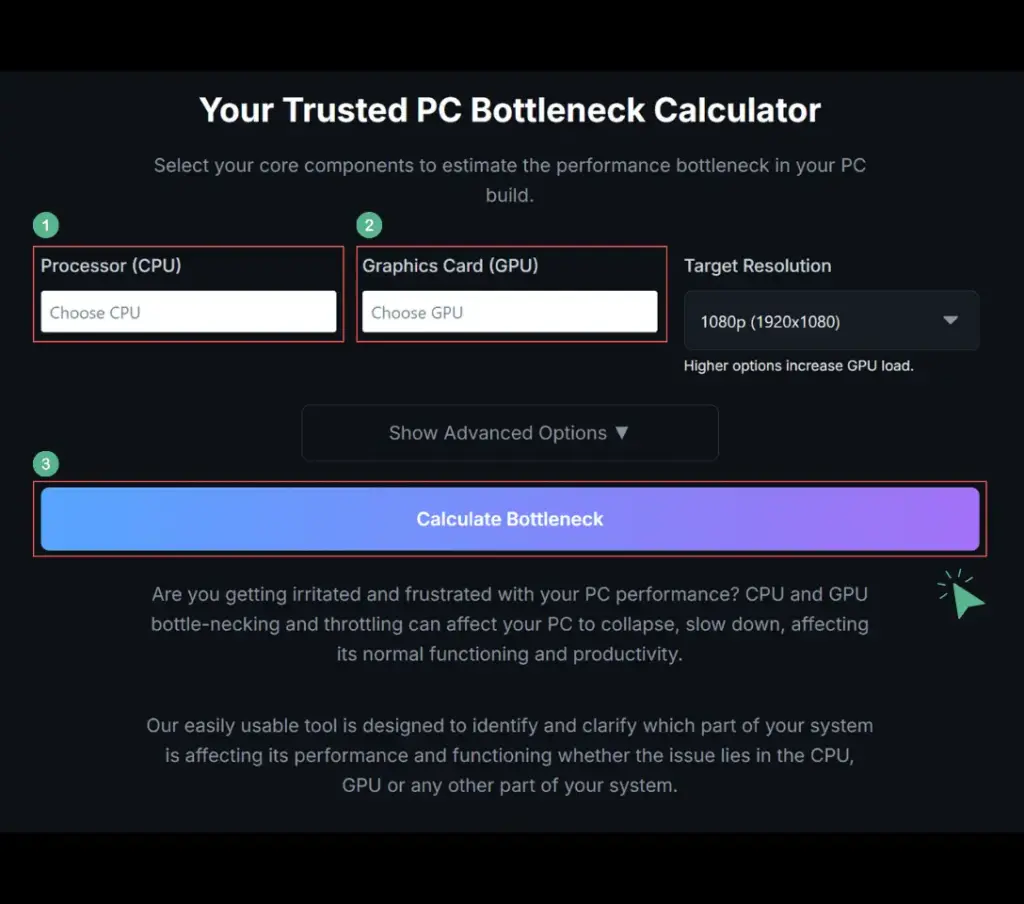
Our smart bottleneck calculator is easy to use. These are the steps to check bottlenecks in your system:
1. Enter Your PC Specs
Entering details of your components in the bottleneck calculator is the first step. This involves:
- CPU: Enter your CPU model and specifications in one section.
- GPU: Provide your current GPU details in the other section.
- RAM: Provide your RAM details and type as well for optimal results.
Some calculators will also ask for your storage drive (e.g., HDD, SSD, NVMe), due to the chance of a storage bottleneck.
2. Analyze the Results
Once the details have been provided to the calculator, the calculator will analyze the details and provide you with the real-time results of your system and evaluate the compatibility of your CPU, GPU, and RAM. This tool will also tell you exactly about the component that is bottlenecking other components.
For example, you might face a CPU bottleneck in your system when your GPU is powerful but your CPU is underpowered and cannot withstand the demands of your system. Likewise, if the CPU is powerful and the GPU is old, that cannot keep up with the CPU. This will lead to a GPU bottleneck.
3. Consider System Optimization Tips
You will be facilitated with the recommended action about the necessary upgrades within your system to resolve the performance issues, after the bottleneck calculator provides you with the results or feedback.
- Upgrading Your CPU or GPU: Upgrading to a more powerful or advanced CPU or GPU is necessary if any of these components shows a bottleneck.
- Overclocking: Overclocking is usually done on high-performance setups to achieve enhanced or extra performance of your CPU or GPU. For instance, a CPU can perform better than normal by overclocking instead of going for an upgrade. Now you have gained knowledge about what overclocking means and what an overclocked component means.
- Adjusting Game Settings: Modifying game settings like resolution or turning off certain graphics-intensive effects can improve the frame rates of your setup if you experience GPU bottlenecking while gaming.
Common Bottleneck Issues and Solutions
Some common bottleneck issues and their solutions are given below:
1. CPU Bottlenecking
When your CPU is too slow or outdated to withstand the demands of new games or high-end software, it’s likely to reflect a CPU bottleneck. High CPU usage, low frame rates, and poor performance in CPU-intensive tasks are the signs of a CPU bottleneck.
Solution: The solution is to optimize your current setup by reducing background processes in your Task Manager or going for a powerful CPU upgrade once you have determined the results of your CPU by using a CPU bottleneck calculator.
2. GPU Bottlenecking
A CPU bottleneck happens when the GPU is stressed too much, causing low productivity in high-end graphics tasks. Insufficient GPU performance leads to stuttering and FPS drops, especially in gaming.
Solution: Likewise, the CPU the GPU bottleneck is resolved by upgrading your GPU or adjusting graphical settings in your games. This is determined once you identify if your GPU is underused by using a bottleneck checker.
3. Memory Bottlenecking
A memory bottleneck occurs due to slow or insufficient RAM within your system. Lag and freezing during demanding tasks are signs of a memory bottleneck.
Solution: Upgrading to a faster memory, like DDR5, or increasing the amount of RAM can help you eradicate memory bottlenecking and enhance overall performance.
How to Optimize CPU and GPU Usage
Utilizing a bottleneck checker can help you identify the bottlenecks in your system. If you are experiencing high CPU usage or GPU throttling. Optimizing your CPU and GPU can be achieved through various methods. CPU optimization can be done by terminating all the background applications and processes to reduce CPU usage. On the other hand, ensuring your system is properly cooled or using overclocking tools can help you resolve GPU throttling.
It’s significant to understand how to increase RAM speed and fix CPU bottlenecks to achieve optimized performance of your PC. Despite the thermal throttling, which can occur as a result of overheating of the component when overclocking your CPU and RAM, it can boost your performance. For gamers, especially those playing Fortnite, fixing frame drops and stuttering can be achieved by optimizing GPU performance, increasing GPU usage, and ensuring your system isn’t thermally throttling.
For adjusting RAM frequency safely, particularly for DDR4 modules, the Overclocking tool is used. Monitoring the clock speed of the CPU with the base speed is the way to check if your CPU is overclocked.
CPU throttling can also impact performance, so it’s essential to test for throttling issues. When it comes to GPUs, lowering usage can sometimes be beneficial for power conservation, but if you’re experiencing low GPU usage, it might indicate a CPU bottleneck.
Conclusion
Whether you are a gamer facing frame drops or a professional needing a workstation for performance, our tool, Smart Bottleneck Calculator, can help you make the right decisions about the required course of action if you experience any bottlenecks within your system. An fps calculator can help you determine the frame rate of your system or game.
By now, you must have been aware of the bottleneck meaning and how it affects your PC. There are different types of bottlenecks in your system; it can be either a CPU-GPU bottleneck or a GPU-CPU bottleneck. Always ensure compatibility and balance between your components, CPU, GPU, RAM, and power supply to eradicate bottlenecks and enhance overall experience.
A PC bottleneck calculator is a valuable tool for anyone seeking to test bottlenecks to optimize their PC’s performance. With the help of a PC bottleneck calculator, addressing these issues becomes much easier, enabling you to unlock the full potential of your system.